
The key facts at a glance
- Yes — emojis usually count as characters, but different platforms may count them differently
- A single emoji is not always one simple character in technical counting — some count as two or more
- Skin tone modifiers, flags, and combined emojis (like families) often use multiple underlying characters
- Emojis can switch SMS messages into Unicode encoding, sharply reducing the per-message character limit
- Always check your actual text in a live counter rather than assuming every emoji costs the same
Do emojis count as characters? Yes — emojis usually count as characters, but different platforms may count them differently. A single emoji might be one character on one platform and two or more on another, depending on how that platform measures text internally.
This guide explains why emoji counting is not as simple as “one emoji, one character,” without claiming to cover every platform’s exact behavior — those details change and vary by system. For a broader overview of everything that counts toward a character limit, see What Counts as a Character?
Quick Answer: Do Emojis Count as Characters?
| Question | Answer |
|---|---|
| Do emojis count as characters? | Yes, on virtually all platforms with a character limit |
| Does one emoji always equal one character? | No — it depends on the emoji and the platform’s counting method |
| Do skin tones and flags cost more? | Often yes — they are built from multiple underlying characters |
| Can emojis affect SMS limits? | Yes — they can trigger Unicode encoding and shrink the per-message limit |
Why Emojis Aren’t Always One Simple Character
To a person, an emoji looks like a single symbol. Underneath, many emojis are encoded using more than one Unicode code point joined together — sometimes with invisible “joiner” characters that tell the system to render multiple pieces as one combined image.
Whether a counting system reports that as “1 character” or “2+ characters” depends entirely on how it counts: some count visible symbols (1 emoji = 1 unit), others count underlying code points (1 emoji = however many parts it’s built from), and others count raw bytes (which can be even higher). This is why the same emoji can show a different character cost on different tools.
Skin Tones, Flags, and Combined Emojis
Several common emoji types are built from more than one underlying character, which is why they tend to cost more than a simple smiley:
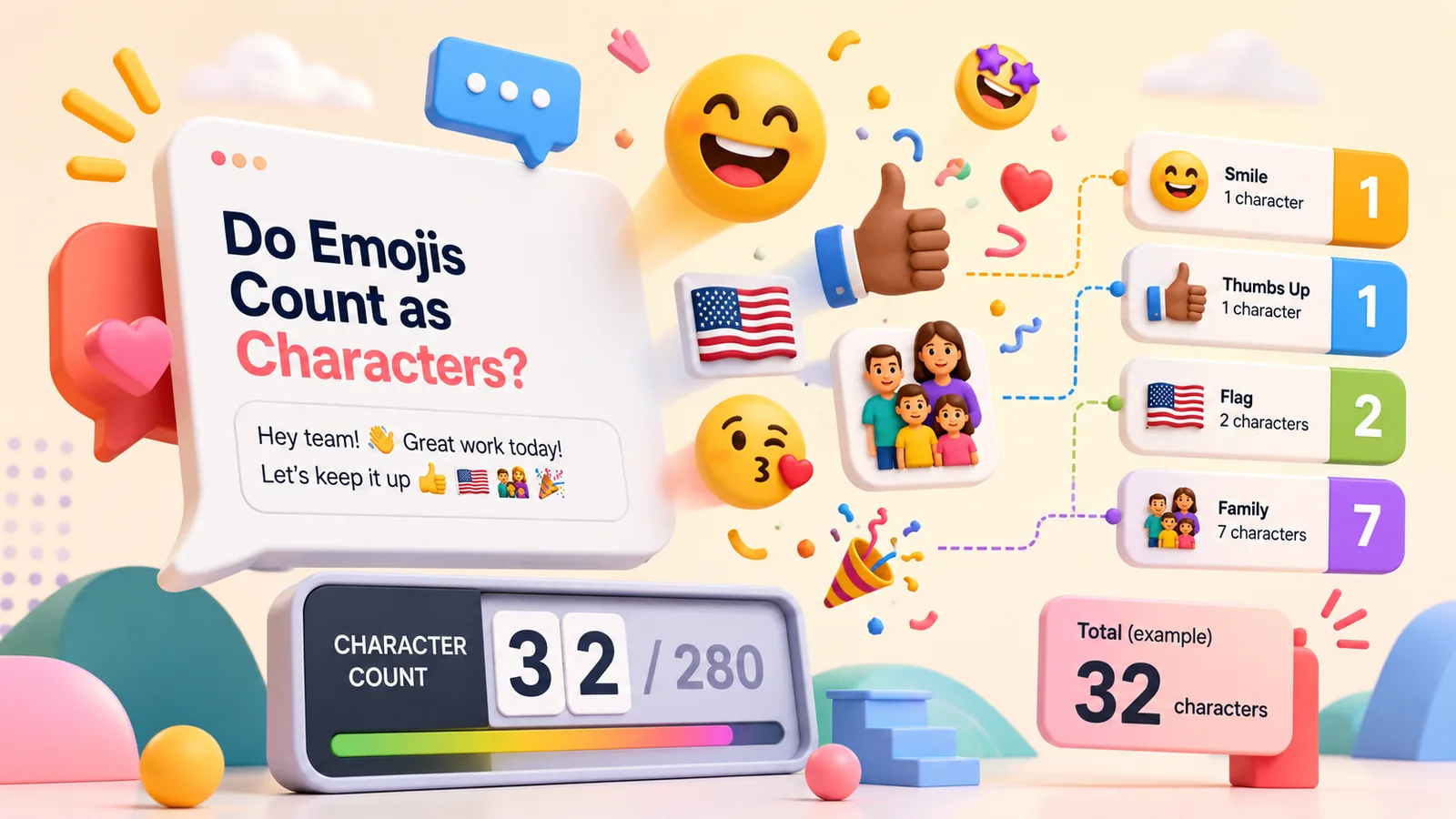
- Skin tone modifiers — adding a skin tone to an emoji like 👍 attaches a separate modifier character to the base emoji, increasing its underlying length
- Flag emojis — most flags are built from two regional indicator characters combined (for example, the two letters of a country code), not a single dedicated flag character
- Family and combined emojis — emojis like a family group are often several individual person emojis joined together with invisible connector characters, making them the most “expensive” common emoji type
- Simple emojis — a plain face or object emoji (😀, ⭐) is usually the cheapest type, often a single code point
None of this is visible when you look at the emoji — it only shows up in the character count.
Why Emojis Can Affect SMS Limits
SMS is the clearest real-world example of emojis changing a limit, not just the count. Standard SMS messages use GSM-7 encoding and allow up to 160 characters per message segment. The moment a message contains a single emoji (or certain other non-GSM-7 characters), most carriers switch the entire message to Unicode encoding — which drops the per-segment limit to around 70 characters, not just for the emoji itself but for the whole message.
That means one emoji can effectively cut your available message length by more than half, even though it visually looks like you only “spent” one character. For the full breakdown of SMS-specific limits, see the SMS Character Limit guide.
Social platforms generally don’t have this all-or-nothing encoding switch, but some apply their own weighted or platform-specific counting rules for emojis — for example, X (formerly Twitter) has historically counted some emojis as more than one character toward its post limit. See the X/Twitter Character Limit guide for more on platform-specific counting.
Avoid assuming any of this is fixed. Platform encoding rules change over time — always verify with your actual text rather than a general rule.
Emoji Character Cost Comparison
| Emoji type | Example | Typical character cost |
|---|---|---|
| Simple emoji | 😀 (smiley face) | Usually 1 character |
| Emoji with skin tone | 👍🏽 (thumbs-up with skin tone) | Usually 2+ characters (base + modifier) |
| Flag emoji | 🇺🇸 (flag emoji) | Usually 2 characters (two regional indicators) |
| Family/combined emoji | 👨👩👧👦 (family emoji) | Often 4+ characters (multiple emojis joined) |
| Emoji in SMS | Any emoji in a text message | 1 emoji can shrink the whole message’s per-segment limit from 160 to ~70 characters |
Exact figures can vary by platform and counting method — treat this as a general pattern, not a universal rule.
Practical Examples
Short caption with simple emojis:
Great day! 😀🎉
Two simple emojis typically add 2 characters to the count, on top of the visible text.
Same caption with a flag and a family emoji:
Great day with family! 🇺🇸 [flag emoji] 👨👩👧👦 [family emoji]
The flag and the family emoji together can add 6 or more characters even though they only display as two symbols — noticeably more than two simple emojis would.
SMS reminder with one emoji:
See you at 3pm! 👍
On a platform with GSM-7/Unicode SMS encoding, adding that single emoji can switch the entire message to Unicode, dropping the per-message limit from 160 to roughly 70 characters — independent of how many characters the emoji itself “costs.”
How to Check Your Real Count
Because emoji counting varies by type and platform, the only reliable way to know your real character count is to check your actual text. Paste your text into the TextLimits character counter to see your exact character count — including emojis — updating live as you type or paste. Your text stays in your browser and is never uploaded.
If you are trimming text with emojis to fit a strict limit, see How to Fit Text Into a Character Limit for general editing techniques, and Do Spaces Count as Characters? and Character Count Without Spaces for how other hidden characters affect your total.
FAQ
Do emojis count as characters? Yes, on virtually all platforms with a character limit. The exact number of characters a given emoji uses can vary by platform and counting method.
Does one emoji always count as one character? No. Simple emojis are often one character, but emojis with skin tone modifiers, flags, and combined emojis (like families) are usually built from multiple underlying characters and can count as two, four, or more.
Do emojis count in SMS messages? Yes, and they can have an outsized effect. Adding even one emoji to a standard SMS can switch the message to Unicode encoding, reducing the per-message limit from around 160 characters to around 70. See the SMS Character Limit guide for details.
Do emojis count in social media character limits? Generally yes, though some platforms apply their own weighted or platform-specific rules for certain emojis. Limits and rules can change, so check the platform’s current behavior with your actual text if you are close to the limit.
Why does my character count change after adding emojis? Because emojis are not all equal in size internally — some are a single character, others are built from multiple combined characters (skin tones, flags, family groups). Adding or removing an emoji can change your count by more than the “1” you might expect.
Try it free
Check your exact character count with emojis
Paste your text into the TextLimits character counter to see your exact character count, including emojis, updating live as you type.
Check your exact character count with emojis →