
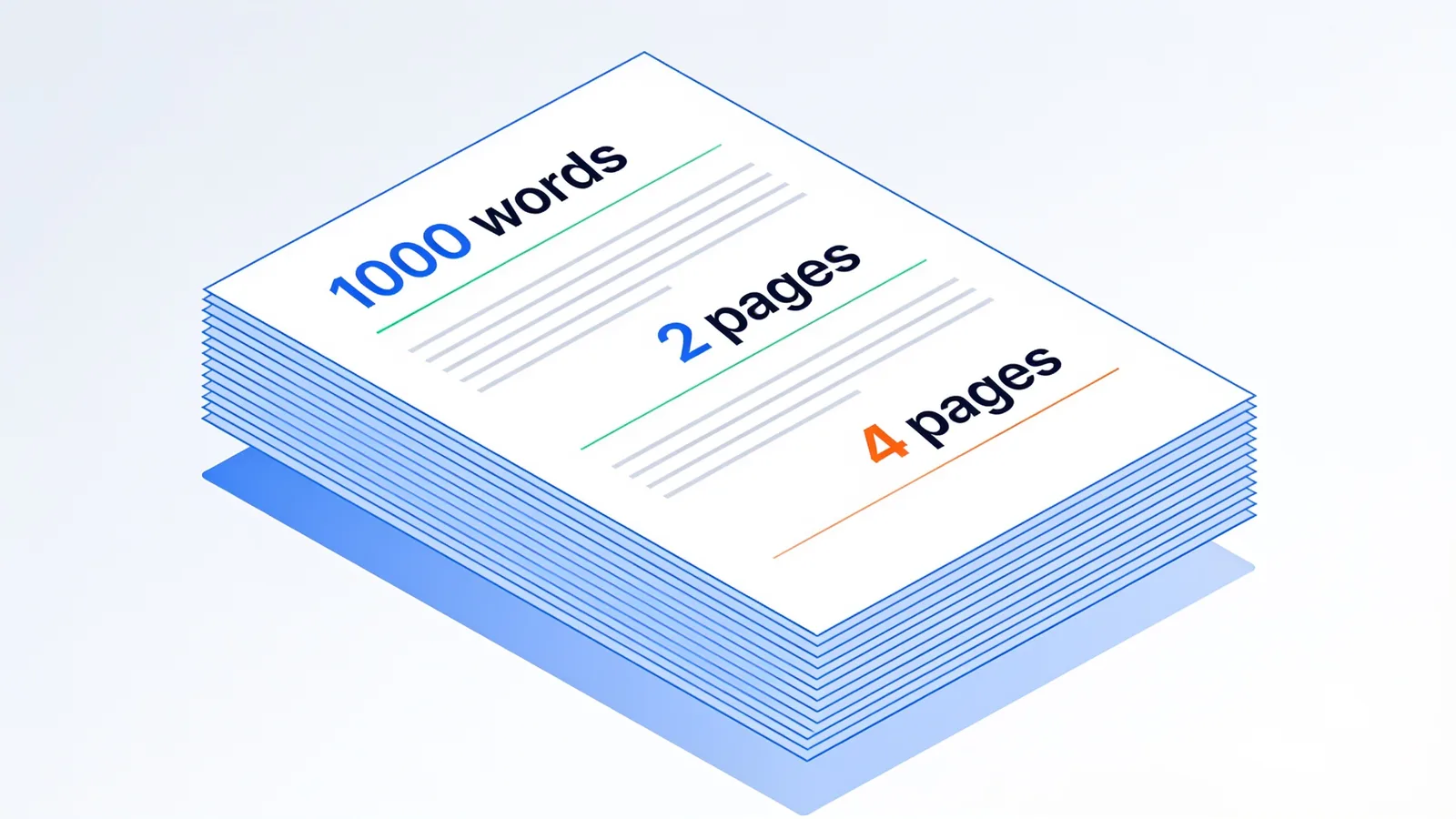
The key facts at a glance
- 1,000 words is usually about 2 pages single-spaced (12pt font, 1-inch margins)
- 1,000 words is usually about 4 pages double-spaced (12pt font, 1-inch margins)
- 1.5 spacing is approximately 3 pages for the same word count
- Estimates assume standard fonts — actual page count varies by font, spacing, margins, and formatting
How many pages is 1000 words? For most standard documents, 1,000 words is about 2 pages single-spaced or 4 pages double-spaced, using 12pt font and 1-inch margins. The actual page count depends on your formatting — font choice, spacing, margin width, and how much of the document is headings, lists, or dialogue can all shift the result.
If you need an estimate for your specific settings, the TextLimits Words-to-Pages Calculator gives you an instant result for any word count.
Quick Answer: 1,000 Words to Pages
| Spacing | Words per page | Pages for 1,000 words |
|---|---|---|
| Single-spaced | ~500 | ~2 pages |
| 1.5 spaced | ~330 | ~3 pages |
| Double-spaced | ~250 | ~4 pages |
All estimates assume 12pt font (Times New Roman, Arial, or Calibri), standard 1-inch margins, and no title page or bibliography. Actual page count may vary.
Double-spaced formatting is standard for most academic essays and US university assignments. Single-spaced is common in professional documents, business memos, and reports.
How Formatting Changes Your Page Count
The same 1,000 words can produce a document anywhere from under 2 pages to well over 4 pages depending on your choices. Here is how each variable affects the outcome.
Single vs. Double Spacing
Line spacing has the largest direct effect on page count:
- Single spacing packs lines as tightly as the font allows — dense and space-efficient
- 1.5 spacing adds a half-line of white space between each line — a common middle ground in some academic and business documents
- Double spacing adds a full empty line between each text line — standard for most academic essays, producing roughly twice the page count of single spacing
Some documents also use paragraph spacing (extra space added above or below each paragraph break). This adds additional white space, especially in documents with many short paragraphs, and can push a document noticeably longer than the line-spacing estimate alone.
Font Size and Font Choice
Font size is one of the biggest formatting variables:
- 12pt is the most common standard for academic and professional documents
- 11pt fits slightly more text per line — a 1,000-word document in 11pt may come in closer to 1.8 pages single-spaced
- 14pt or larger can stretch a 1,000-word document to nearly 3 pages single-spaced
Font choice also matters, though less dramatically than size:
- Times New Roman is relatively compact and is the benchmark for most page estimates
- Arial and Calibri use slightly wider characters at the same point size — the same text in Arial may run slightly longer than in Times New Roman
- Georgia is a little wider than Times New Roman and may add a fraction of a page to longer documents
For most practical purposes, the difference between common fonts at 12pt is usually less than half a page for a 1,000-word document.
Margins, Paragraphs, and Headings
Margins directly control how many words fit per line:
- Standard margins of 1 inch (2.54 cm) on all sides are the most common setting
- Wider margins (1.25 or 1.5 inches) reduce words per line and increase page count
- Narrower margins produce a denser page
Paragraph structure affects how efficiently your words fill each page:
- Long flowing paragraphs use space efficiently — the text fills each line close to the margin
- Short paragraphs, dialogue, and lists create frequent line breaks that leave partial lines, pushing the document longer
- A 1,000-word document written mostly as dialogue or bullet points may run 20–30% longer than one written in solid paragraphs
Headings break up text but consume vertical space. A document with six H2 headings uses more space than the same word count with no headings — the heading text itself, plus any spacing above and below, adds up quickly.
Words to Pages Conversion Chart
Estimates below assume 12pt font, standard 1-inch margins, and a common font (Times New Roman, Arial, or Calibri). Actual results vary by formatting.
| Word count | Single-spaced | Double-spaced |
|---|---|---|
| 500 words | ~1 page | ~2 pages |
| 750 words | ~1.5 pages | ~3 pages |
| 1,000 words | ~2 pages | ~4 pages |
| 1,500 words | ~3 pages | ~6 pages |
| 2,000 words | ~4 pages | ~8 pages |
| 5,000 words | ~10 pages | ~20 pages |
For word counts beyond this range, or for non-standard formatting, use the Words-to-Pages Calculator to get an estimate for your specific settings.
Real-World Examples
Single-spaced, 12pt Times New Roman, 1-inch margins About 2 pages. Dense and compact — typical for a business memo, a short brief, or a formatted report section.
Double-spaced, 12pt Times New Roman, 1-inch margins About 4 pages. The standard format for most academic essays and university assignments.
Single-spaced, 11pt, 1-inch margins Around 1.8 pages. Slightly more compact than 12pt — often used in reports and technical documents.
Double-spaced, 11pt, 1-inch margins Around 3.6 pages. The difference from 12pt double-spaced is noticeable but usually not dramatic.
12pt Arial or Calibri vs Times New Roman Arial and Calibri are slightly wider at the same point size. A 1,000-word document in Arial may run slightly over 2 pages single-spaced when the same text in Times New Roman fits in 2.
Document with multiple headings and short paragraphs A 1,000-word document structured with 6–8 headings, short paragraphs, and bullet lists can approach 3 pages single-spaced due to the extra white space created by frequent line breaks and heading blocks.
US Letter vs A4 paper US Letter (8.5 × 11 in) and A4 (210 × 297 mm) are both standard paper sizes. They are similar enough that the words-per-page estimate is approximately the same for both when using standard 1-inch margins — the difference is much smaller than the effect of changing your font size or spacing.
How to Calculate Your Exact Page Estimate
Reference tables give useful starting estimates, but they cannot know your exact document settings. The actual page count for your words depends on the specific font, font size, line spacing, paragraph spacing, margin widths, and content structure you are using.
Use the TextLimits Words-to-Pages Calculator to estimate your page count from your exact word count, spacing, and font size. You can try different spacing and font-size settings to see how each one changes the estimate.
Need to count your words first? Paste your draft into the free word counter to see your word count, character count, and estimated reading time — all updating live as you type.
For estimated reading time on a 1,000-word piece, see the Reading Time Calculator — useful for articles, essays, blog posts, and presentations.
Your text stays entirely in your browser. Nothing is stored or sent anywhere.
FAQ
How many pages is 1,000 words double-spaced? About 4 pages, using 12pt font and 1-inch margins. This is the standard estimate for academic essays and most US university assignment formats. Larger fonts, wider margins, or a document with many headings may push the page count slightly higher.
How many pages is 1,000 words single-spaced? About 2 pages, using 12pt font and 1-inch margins. Single-spaced documents are more compact and are common in professional reports, memos, and business documents. At 11pt the same word count may fit in around 1.8 pages.
Is 1,000 words a lot for an essay? For most undergraduate short-answer assignments and response papers, 1,000 words is a short-to-medium piece. Many standard assignments run 1,000–2,000 words. It is enough to introduce a topic, develop one main argument with evidence, and reach a conclusion. For a research essay or major project, 1,000 words is generally considered brief.
How many paragraphs is 1,000 words? At a typical paragraph length of 100–150 words, 1,000 words produces around 6–10 paragraphs. Academic paragraphs often run 100–200 words. There is no fixed rule — paragraph length should follow the content, not the word count.
Does font size change the page count? Yes, noticeably. Moving from 12pt to 14pt can add nearly a full page to a 1,000-word document single-spaced. Moving to 11pt brings it slightly under 2 pages. Font size has a larger impact on page count than font choice does.
Does spacing change the page count? Yes — it is the single biggest variable. Double-spaced text produces roughly twice as many pages as single-spaced text for the same word count. If a document looks longer or shorter than expected, checking the line-spacing setting is usually the first step.
How can I calculate pages for my exact word count? Use the TextLimits Words-to-Pages Calculator. Enter your word count and select your spacing and font size to get an estimate instantly. You can also use the character counter if you need to work from a character count rather than a word count.
Is 1,000 words always 4 pages double-spaced? Not always — the 4-page figure is a useful estimate, not a guarantee. Larger font sizes, wider margins, multiple headings, short paragraphs, or generous paragraph spacing can push a 1,000-word document beyond 4 pages. Always check your actual document settings rather than relying on the estimate alone.
Does word count include the bibliography or references? This varies by institution, discipline, and assignment guidelines. In many academic contexts, the reference list, bibliography, footnotes, and title page are not counted toward the stated word limit. Always check the specific guidelines for your assignment or submission.
Try it free
Use the Words-to-Pages Calculator
Enter your word count and choose your spacing and font size to get an instant page estimate — no sign-up required.
Use the Words-to-Pages Calculator →