
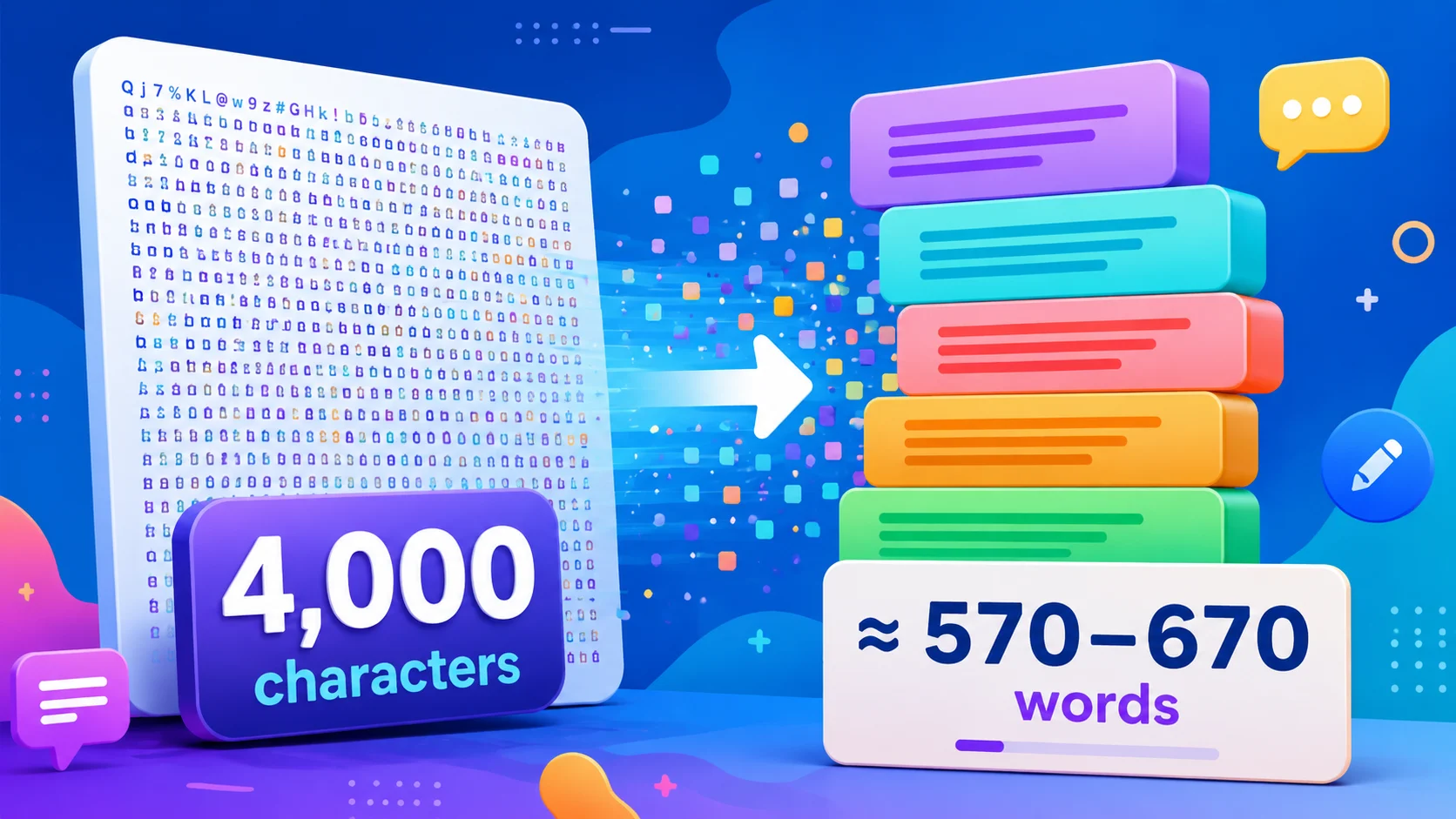
If you are filling out an application form, writing a personal statement, or drafting text for an online box, you might be wondering how many words is 4000 characters. In standard English prose, 4,000 characters is usually about 570 to 670 words when spaces are counted. The exact number depends on word length, punctuation, spacing, and whether the platform counts spaces.
This guide shows you what 4,000 characters looks like, where you will encounter this limit, and how to check your exact count before you submit.
Quick Answer: How Many Words is 4000 Characters?
| Counting method | Approximate word count |
|---|---|
| 4,000 characters with spaces | about 570–670 words |
| 4,000 characters without spaces | about 700–800 words |
| Short-word text | more words |
| Technical or long-word text | fewer words |
These are estimates for typical English prose. The actual word count depends on:
- Average word length — short common words (“the”, “is”, “in”) pack more words into the same character budget; longer professional or technical terms reduce the count
- Punctuation density — commas, periods, dashes, and other marks each consume one character
- Spaces — if the platform counts spaces, each gap between words uses one character from your budget
- Line breaks — pressing Enter or Return generally counts as one character
A useful frame: 4,000 characters is roughly four times a 1,000-character block. If you know what 1,000 characters looks like, multiply by four.
4000 Characters to Words: The Simple Estimate
The most common reason people look this up is to plan text for a form field or to understand how much they have written.
The short answer is:
- With spaces: roughly 570 to 670 words
- Without spaces: roughly 700 to 800 words
The range exists because different writers use different word lengths. Conversational prose with short common words — “and”, “the”, “but”, “you” — gets more words into 4,000 characters than formal writing with longer technical terms.
A 4,000-character limit with spaces is longer than most email bodies, detailed enough for a solid application answer, and about four times the length of a 1,000-character block. It is a meaningful amount of text — not unlimited, but enough for a focused, well-developed response.
For comparison, 3,000 characters is usually about 430 to 600 words. At 4,000 characters you have roughly 140 to 170 additional words, which is the equivalent of another paragraph or two.
Does 4000 Characters Include Spaces?
Usually yes. Most online platforms and form fields count every character — spaces, punctuation, and line breaks — toward the total limit. When a form simply says “4,000 characters,” you should assume spaces are included unless the field explicitly says “characters excluding spaces.”
Why it matters: spaces typically account for around 15–20% of any block of prose. In a 4,000-character passage, that is roughly 600 to 800 characters going to whitespace rather than visible words. If the limit excludes spaces, you have significantly more room to write.
For more detail on how this works across different platforms, see: Do Spaces Count as Characters?
4000 Characters With Spaces vs Without Spaces
| Measure | What it means | Approx. words |
|---|---|---|
| 4,000 chars with spaces | Every letter, punctuation mark, and space counts | about 570–670 |
| 4,000 chars without spaces | Only letters, digits, and punctuation count | about 700–800 |
When a platform excludes spaces, 4,000 non-space characters is roughly equivalent to 4,700–4,900 total characters — because adding the spaces back in typically adds 15–20% to the total character count.
If you are unsure which applies, paste your text into the TextLimits character counter — it shows both counts side by side, updating live.
What 4000 Characters Looks Like
Example: 4000 Characters With Spaces
Below is an exact 4,000-character sample — a complete professional application response. The compact display lets you see the full volume of text at a glance.
Exact 4,000-character sample
Count includes spaces and paragraph breaks.
In this role, I led the end-to-end design and delivery of a new client onboarding platform, working across product, engineering, compliance, and customer success teams to define requirements, prioritize features, and manage delivery against a fixed regulatory deadline. The project required close collaboration with legal and risk teams to ensure the platform met data protection requirements in three jurisdictions, and with the engineering team to manage a significant technical migration from a legacy system while maintaining service continuity for existing clients. I was the primary point of contact for external system integrators during the migration phase and coordinated sign-off across four internal departments before go-live. I have attached supporting documentation including the project summary, key metrics, and a brief case study from the pilot phase for your review.
I was responsible for stakeholder communication throughout, including monthly updates to the executive leadership team, weekly sprint reviews with the product and engineering team, and regular touchpoints with key client contacts during the pilot phase. I produced the initial product requirements document, facilitated discovery workshops with users and subject matter experts, and maintained the backlog across a six-month delivery cycle. The final platform reduced average client onboarding time by 38 percent against our internal benchmark and received strong positive feedback in post-launch user research. Separately, I contributed to a working group reviewing the organization approach to AI-assisted processes in regulated workflows, including identifying risk-appropriate use cases and drafting an internal guidance note on responsible deployment. The working group report was reviewed by the compliance committee and adopted as internal policy within three months of submission.
Prior to this role, I spent four years as a senior product analyst at a mid-sized financial technology company, where I was responsible for defining data requirements for a suite of compliance reporting tools used by over two hundred enterprise clients. That work required detailed stakeholder engagement with legal, operations, and technology teams, as well as close coordination with external auditors during annual review cycles. I developed a strong foundation in regulated product environments, structured requirements processes, and cross-functional delivery during that period, which directly informed my approach to the onboarding platform project described above. I hold a degree in Business Information Systems and have completed professional development in product management, agile delivery, and data governance over the past several years. I am also experienced in supporting hiring processes for product and analytics roles, having conducted over sixty interviews and contributed to team growth from six to fourteen people during my most recent position.
In terms of working style, I operate best in environments where there is clarity of ownership, a bias toward shipping, and a genuine culture of feedback at all levels of the team. I am comfortable with ambiguity at the strategy level but prefer clear agreements on scope and delivery at the execution level. I have managed relationships with external vendors and third-party integrators, negotiated SLAs, and contributed to procurement decisions on two occasions. I bring a structured approach to prioritization, using a combination of impact scoring, cost of delay, and stakeholder input to sequence work rather than relying on gut feel or seniority alone. Outside of formal work, I contribute to a product management community, facilitating monthly discussions on capacity planning and discovery methods in smaller product teams. I am drawn to roles where product decisions are grounded in user evidence, where the team iterates based on evidence rather than assumption, and where there is a shared sense of what good looks like. References on request.
That is a typical length for a detailed application answer, a personal statement section, or a grant project description — focused and substantive, with room for context, evidence, and a clear closing.
Example: 4000 Characters Without Spaces
When a form specifies 4,000 characters excluding spaces, the visible content is noticeably longer. A 4,000-character-without-spaces block contains approximately 4,700–4,900 total characters, or around 700–800 words — roughly an additional 100 to 150 words compared to the with-spaces version above.
This distinction matters most in academic and institutional submissions, where forms sometimes specify “characters excluding spaces” to allow more substantive content than a raw character count would suggest.
Common Places With 4000-Character Limits
A 4,000-character limit appears in a range of online contexts:
- Application forms — job application systems, graduate program applications, and scholarship portals often cap individual question answers at 3,000–5,000 characters; 4,000 is a common middle point
- Personal statements — some university application fields and professional body submissions use 4,000-character limits for personal or supporting statements
- Product and service descriptions — e-commerce platforms, app stores, and listing sites often allow 4,000 characters for full product descriptions
- Grant and funding applications — project description fields frequently sit in the 2,000–5,000 character range, with 4,000 being a common ceiling
- Online review and feedback fields — some platforms allow extended reviews in the 3,000–5,000 character range
- Long captions and comments — some content platforms allow extended captions or threaded comments at this length
In almost all of these cases, spaces are counted. If you are close to a 4,000-character limit, use a live counter to check your exact total before submitting.
How to Check Your Exact Word and Character Count
The most reliable way to know whether your text fits within 4,000 characters is to paste it into a live counter and read the number directly — not to estimate from a word count.
Use the TextLimits character counter — paste your text and see the exact character count with spaces, character count without spaces, and word count, all updating live as you type. Your text stays entirely in your browser and is never stored or sent anywhere.
If you need word count alongside your character count, the free word counter shows both together.
For social media platforms with their own specific limits, the social media character counter lets you check your text against platform presets in real time.
Practical tips:
- Write your draft freely first, then paste in and trim to fit
- Check whether your form counts spaces — if not specified, assume spaces count
- Remove trailing spaces and blank lines before your final count — these are easy to miss after copy-pasting
- If you need to cut text to fit within 4,000 characters, see the guide on how to reduce character count for practical editing techniques
If you need to understand how much of a page 4,000 characters represents, the words to pages calculator can convert your approximate word count to page estimates.
Frequently Asked Questions
How many words is 4,000 characters? Usually about 570 to 670 words when spaces are counted, or about 700 to 800 words when spaces are not counted. The exact figure depends on average word length, punctuation, and how the platform handles spaces. Use a character counter for your precise count.
How many pages is 4,000 characters? Roughly 1 to 1.5 pages of standard prose, based on the estimate of 570–670 words at 4,000 characters with spaces. At 250–300 words per page (typical for double-spaced 12-point text), that is about 2 pages. At 500 words per page (single-spaced), it is just over 1 page. Use the words to pages calculator for a more precise estimate.
Do spaces count in a 4,000-character limit? Usually yes. Most forms and platforms count spaces as characters. If the form says “characters excluding spaces,” only letters, digits, and punctuation count. When no qualification is given, assume spaces count. See: Do Spaces Count as Characters?
How long does it take to read 4,000 characters? At an average adult reading speed of around 200–250 words per minute, and with 4,000 characters holding approximately 570–670 words, the reading time is roughly 2 to 3 minutes. A faster reader may get through it in under 2 minutes; a slower or careful reader might take 3 to 4 minutes.
Is 4,000 characters enough for an essay? It is enough for a focused short essay or extended response. At approximately 570–670 words, 4,000 characters with spaces gives you enough space for a clear argument with two or three supporting points and a brief conclusion. It is not enough for a full academic essay (which typically runs 1,500–3,000 words), but it is appropriate for a detailed application answer, a personal statement section, or a structured professional response.
How do I check if my text is exactly 4,000 characters? Paste your text into the TextLimits character counter. The count updates live as you type or paste, showing both characters with spaces and characters without spaces. Trim or expand your draft until the count reads exactly 4,000. The counter also shows word count so you can see both figures at once.
Try it free
Check your character count free
Paste your text into the TextLimits character counter to see your exact character count with spaces, without spaces, and word count — all updating live.
Check your character count free →